
In this article
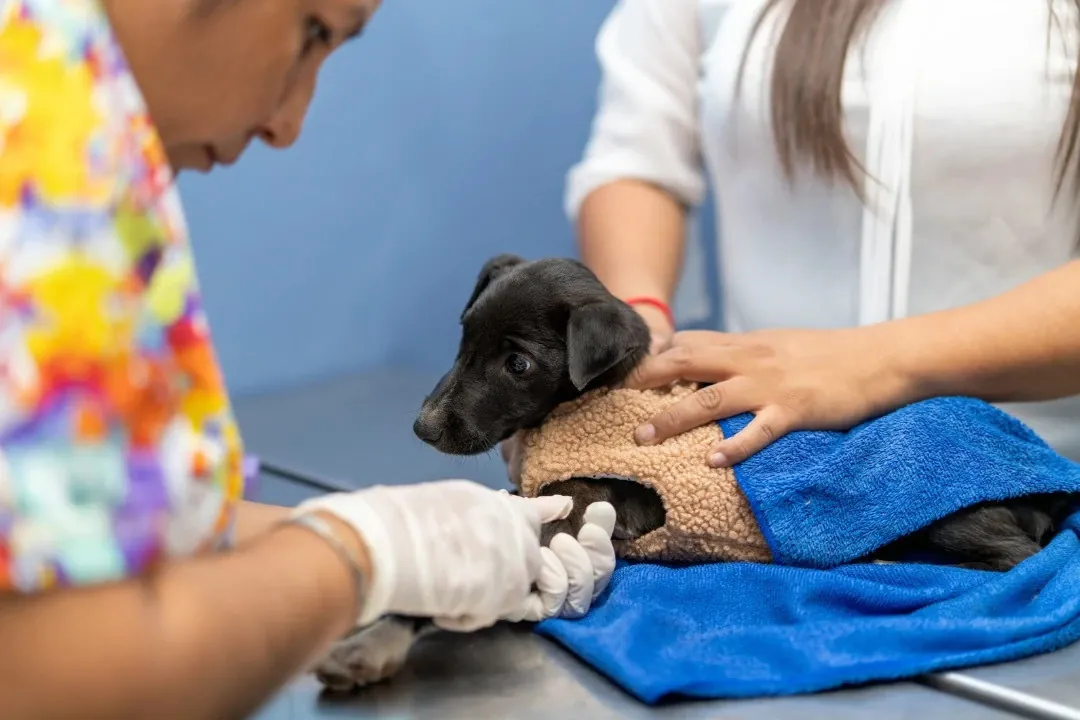
The difference between spay and neuter comes down to your pet's sex. A spay is surgery for a female, and a neuter is surgery for a male. Both stop your dog or cat from having puppies or kittens, and both can protect their health for years. If you're looking for a veterinarian near me in Oakville, our team at Speers Road Animal Hospital does spay and neuter surgery right here in the clinic. This guide covers which surgery your pet needs, the best age for it, surgery day, and healing at home.
What Is the Difference Between Spay and Neuter?
The difference between spay and neuter is which organs are removed. A spay removes a female's ovaries, and usually her uterus. A neuter removes a male's testicles. Both are done under general anesthesia, so your pet is fully asleep and feels no pain during surgery. Both also stop the body from making most of its reproductive hormones. That's why they prevent pregnancy and change some health risks and behaviours too.
You'll also hear people call it "fixing" or "sterilizing" a pet. The word "neuter" is sometimes used for both sexes too, which causes a lot of confusion. In everyday talk, though, spay means female and neuter means male.
What a Spay Is
A spay is surgery that removes a female dog's or cat's ovaries, and in most cases her uterus too. The full medical name is ovariohysterectomy, which means removing the ovaries and uterus. When only the ovaries are removed, it's called an ovariectomy. The American College of Veterinary Surgeons says research shows no long-term difference in outcome between the two.
The ovaries and uterus sit inside the belly, so the vet makes a small cut into the belly, usually along the middle. That makes a spay the bigger of the two surgeries.
What a Neuter Is
A neuter is surgery that removes both of a male dog's or cat's testicles. The medical name is castration, or orchiectomy. In most males the testicles sit outside the body, so the vet doesn't need to open the belly. In dogs, the small cut is usually made just in front of the scrotum. In cats, it's often made on the scrotum itself. As a result, a neuter is usually shorter and simpler than a spay, and many pets bounce back a little faster.
Spay or Neuter: Which One Does Your Pet Need?
Your pet needs a spay if she's female and a neuter if he's male, whether your pet is a dog or a cat. That part is simple. The harder questions are when to do it, and whether your pet's health changes the plan. Your vet works that out at an exam.
A few situations call for a closer look before surgery is booked:
- Your pet came from a rescue or shelter, and you don't know if they've been fixed
- Your male puppy has only one testicle you can see or feel, or none
- Your female is in heat right now, or may be pregnant
- Your pet is older or has a health problem such as heart or kidney disease
- Your dog is a large or giant breed that's still growing
- Your pet has had trouble with anesthesia or surgery before
If You Don't Know Whether Your Pet Has Been Fixed
If you don't know whether your pet has been fixed, start with the adoption paperwork, then book an exam. Many shelters and rescues fix pets before adoption. For males, the vet can usually tell during the exam. Females are harder, because a spay scar is small and fur can hide it. The vet may look for a scar or a small tattoo that some clinics leave, and will talk you through next steps.
Male Pets With a Retained Testicle
A male pet with a retained testicle still needs a neuter, and it matters even more for him. A retained testicle (cryptorchidism) never dropped into the scrotum and stays in the groin or belly instead. Cornell University's Riney Canine Health Center says these dogs have a much higher risk of testicular cancer and of the testicle twisting. Cornell recommends neutering, with both testicles removed. Finding a testicle inside the belly can make the surgery longer, so your vet will explain what's involved before booking.
Spay vs Neuter: How the Two Surgeries Compare
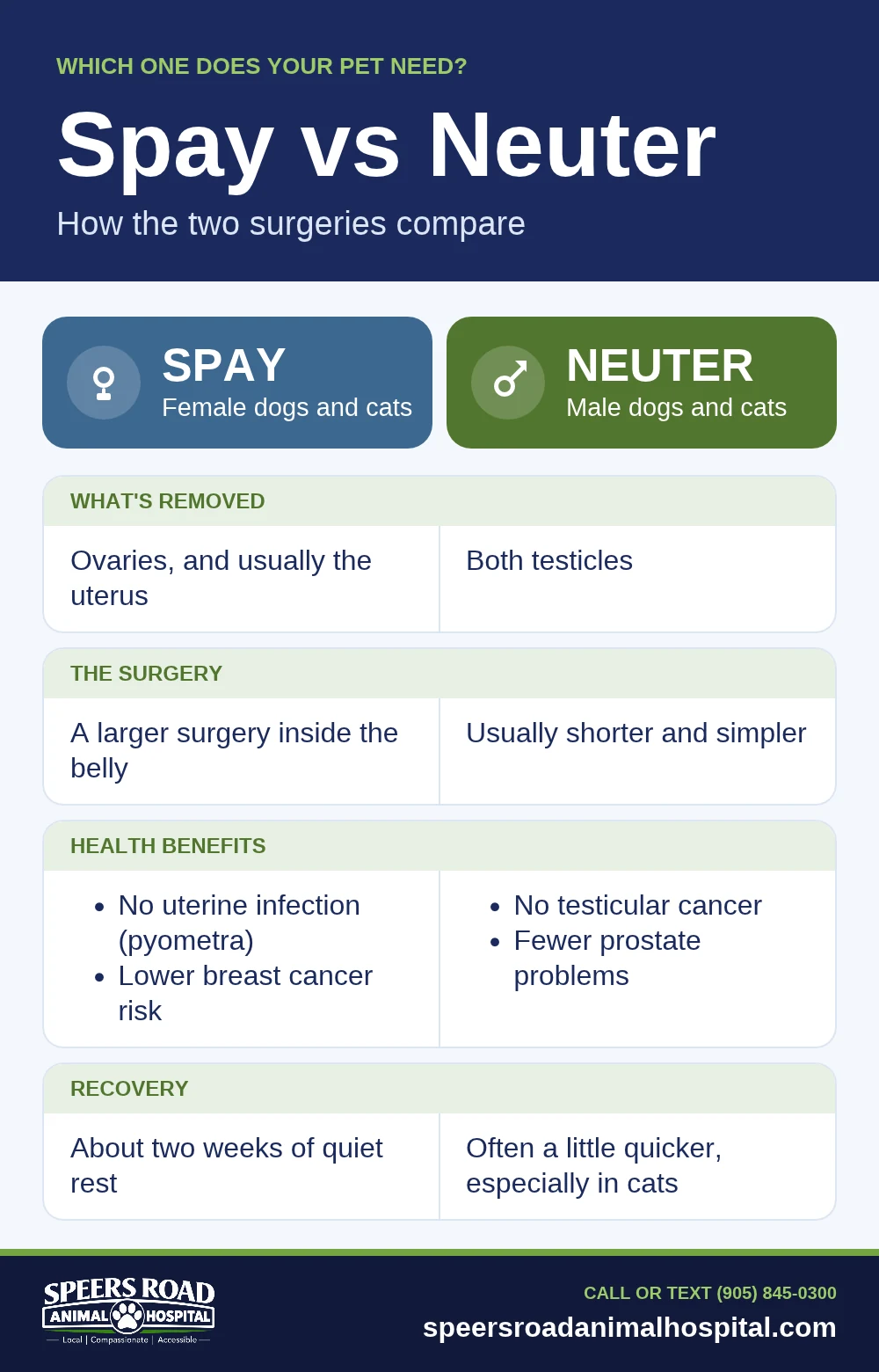
Spay vs neuter surgery differs mainly in where the vet works and how big the surgery is. The goals are the same. A spay goes inside the belly and a neuter usually doesn't, which affects how long surgery takes and how quickly your pet recovers.
The table below shows how the two surgeries generally compare, with our current prices.
| What to compare | Spay | Neuter |
|---|---|---|
| Who it's for | Female dogs and cats | Male dogs and cats |
| What's removed | Ovaries, and usually the uterus | Both testicles |
| Where the cut is | The belly, usually along the middle | In front of or on the scrotum; the belly only if a testicle is retained |
| How involved it is | A larger surgery inside the belly | Usually shorter and simpler |
| Main health benefits | No uterine infection (pyometra), lower breast cancer risk | No testicular cancer, fewer prostate problems |
| Our price | Cat $599, dog from $699 | Cat $299, dog $599 |
Prices are in Canadian dollars, plus tax, and include anesthesia, the surgery and medication to go home. Bloodwork is included with every surgery except the cat neuter. Our surgical care page has the full details, including the $99 mature pet surgical fee that may apply.
Health Benefits and Risks of Spaying and Neutering
The health benefits of spaying and neutering come from removing organs that can get diseased later and from lowering hormones. The Canadian Veterinary Medical Association strongly recommends spaying or neutering cats and dogs that aren't meant for breeding. It also says the timing for a pet in a home should be decided with your vet, because there are risks and benefits either way.
Benefits for Female Pets
The main benefits for female pets are protection from a serious uterine infection and a lower risk of breast cancer. The infection, called pyometra, fills the uterus with pus. It often shows up in the weeks after a heat and can make a pet very sick, often needing emergency surgery. The American College of Veterinary Surgeons says spaying removes the chance of pyometra. It also greatly lowers the chance of breast cancer, especially when done before the first heat. On top of that, a spay ends heat cycles, the bleeding that comes with them in dogs, and the risk of an unplanned litter or a hard birth.
Benefits for Male Pets
The main benefits for male pets are no risk of testicular cancer and a lower chance of prostate problems. Once the testicles are gone, testicular cancer can't develop. An enlarged prostate is common in older male dogs who aren't neutered, and it can make it hard to pee or poop. Neutering lowers that risk. It also ends the urge to find a female in heat, which drives a lot of roaming, marking and fighting.
The Trade-Offs to Talk About With Your Vet
The trade-offs of spaying and neutering are a few health risks that can go up once the hormones are gone. Some spayed females start leaking urine as they get older, which may need daily medicine. Some large-breed dogs may have a higher chance of certain joint problems and cancers if fixed young. That's why big dogs are often fixed later. Fixed pets also tend to need fewer calories, so weight gain is common unless meals are adjusted. These risks are mostly a reason to choose the timing with care, and we talk them through with you.
The "One Litter First" Myth
The idea that a female should have one litter before she's spayed is a myth. There's no proven health benefit to letting a female have a litter, and every pregnancy and birth carries its own risks. Waiting for a litter also gives away some of the breast cancer protection a spay offers.
Behaviour Changes After Spaying or Neutering
Behaviour changes after spaying or neutering are mostly about the urge to mate, not about who your pet is. The surgery lowers the hormones behind heat cycles and mate-seeking, so behaviours driven by those hormones often fade. Behaviours that come from training, fear or personality usually stay the same.
What Often Changes
What often changes after surgery are the behaviours linked to finding a mate. The CVMA notes that neutering can reduce urine marking, mounting and roaming in dogs, and that spaying prevents heat behaviour in female cats. Here's what many owners notice:
- Heat cycles end, along with the bleeding in female dogs
- Female cats stop the loud yowling, rolling and restlessness of being in heat
- Male dogs and cats often roam less and try to escape less
- Urine marking and spraying often drop, especially in male cats
- Mounting and fights with other males may happen less often
Results vary. A dog who has marked for years may keep some of the habit. If a neutered cat is still spraying, book a visit, since stress or a bladder problem can be the cause.
What Doesn't Change
What doesn't change after a spay or neuter is your pet's basic personality. A playful dog usually stays playful, and a cuddly cat stays cuddly. Surgery also isn't a fix for training problems such as pulling on the leash, jumping up or fear of strangers. Those respond to training, and to a vet visit if fear or aggression is new.
When Should You Spay or Neuter Your Pet?
You should spay or neuter your pet at an age that suits their species, size and lifestyle. For dogs, size matters most. The American Animal Hospital Association (AAHA) sorts dogs by expected adult weight, with about 20 kg (45 lb) as the dividing line.
Our guide to puppy and kitten care treats the spay or neuter plan as the last step of the first six months. In our Healthy Start at Speers Road Program, a spay or neuter consult is part of the final visit at about six months. The surgery itself is booked after that talk.
Cats
Cats are usually spayed or neutered at around five to six months of age. The American Veterinary Medical Association and the American Association of Feline Practitioners support fixing cats by five months. That's because female cats can get pregnant that young. The same advice applies to indoor cats. A female in heat will try hard to get outside, and many unneutered males start spraying in the house. If your kitten might slip outdoors or lives with an unfixed cat, tell us early so we can plan.
Small-Breed Dogs
Small-breed dogs, those expected to weigh under about 20 kg (45 lb) as adults, are usually fixed at around six months. AAHA guidelines suggest neutering small males at about six months, and spaying small females before their first heat, at about five to six months. Some small dogs come into heat early, so it helps to plan the date ahead of time.
Large-Breed Dogs
Large-breed dogs are usually fixed later, after they've finished growing. For males expected to weigh 20 kg (45 lb) or more, AAHA suggests neutering after growth stops, at about nine to fifteen months. For large females, the window is wider, about five to fifteen months, and your vet narrows it based on her health risks and your home. A later spay can mean one or more heat cycles first, so plan how to keep her away from male dogs.
Adult and Senior Pets
Adult and senior pets can be spayed or neutered too, so it's never too late to ask. The American College of Veterinary Surgeons notes the surgery can be done on dogs of any age. Older pets get a careful health check first, and bloodwork matters more as pets age.
What Happens on Surgery Day at Speers Road Animal Hospital
On surgery day, your pet is checked, put fully to sleep, watched closely, and sent home with a recovery plan. At Speers Road Animal Hospital, the surgery is done right here by Dr. Abdul R. Alashraf, who holds a PhD in Small Animal Medicine. The vet who examines your pet is the same vet who operates and follows them through recovery.
Here's what usually happens, step by step. First, Dr. Abdul examines your pet and goes over the surgery and the estimate with you. Most pets need an empty stomach for anesthesia, so ask us when to stop food the night before. On the day, every patient gets a health check before anesthesia. Pre-anesthetic bloodwork is included with cat spays, dog neuters and dog spays. It can show whether the liver and kidneys are ready for anesthesia. Your pet gets pain relief before, during and after surgery, and is monitored through the surgery and while waking up.
When it's time to go home, you'll get clear aftercare instructions and the medication your pet needs. Ask any questions before you leave, since it's easier than wondering late at night whether a little redness is normal.
Recovery and Aftercare After a Spay or Neuter
Recovery after a spay or neuter usually takes one to two weeks, and it's mostly about keeping your pet calm while the cut heals. Spayed pets usually need about two weeks of quiet rest, because the surgery goes inside the belly. Neutered pets often heal a little quicker, especially cats. Many pets feel fine after a day or two, which is exactly why they need help slowing down.
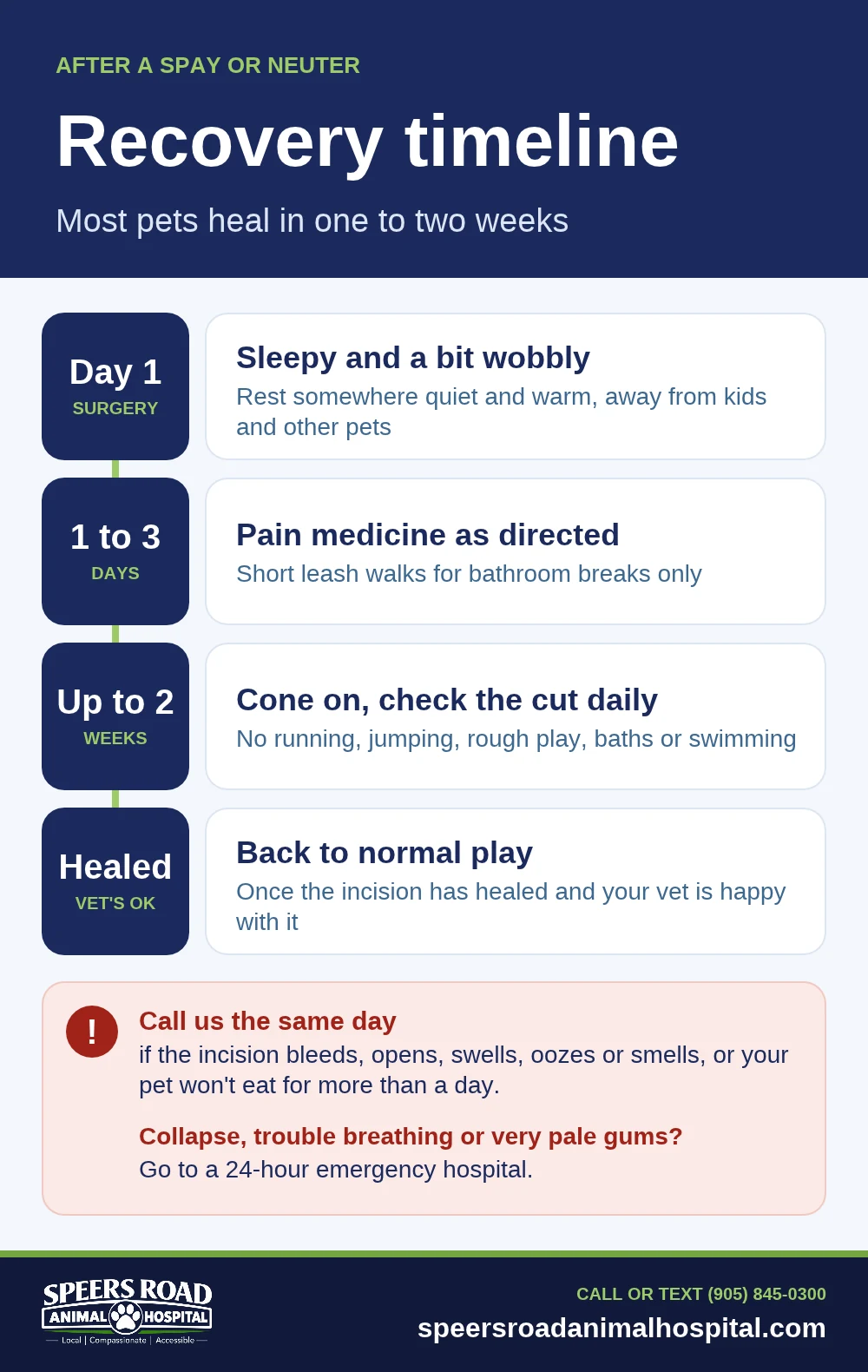
On the first day, expect your pet to be sleepy and a bit wobbly as the anesthetic wears off. Give them a quiet, warm spot away from kids and other pets. For the first few days, give any pain medicine exactly as directed, and keep outings to short leash walks for bathroom breaks. For about two weeks, avoid running, jumping, rough play and off-leash time, which matches the American College of Veterinary Surgeons' advice after a spay.
Keep the cone (e-collar) or a soft recovery suit on the whole time, so your pet can't lick or chew the incision. Check the cut once a day, and skip baths and swimming until your vet says it has healed. Normal play can start once the incision has healed and your vet is happy with it.
Call us the same day if you notice any of these during recovery:
- Bleeding from the incision, or a cut that has opened
- Swelling, redness or heat that gets worse instead of better
- Pus, a bad smell or other discharge from the incision
- Your pet won't eat for more than a day, or keeps vomiting
- Straining to pee, or not peeing at all
- Low energy that gets worse after the first day
- A cone that has come off, and a pet who is licking or chewing the cut
We offer same-day visits for urgent problems during open hours. If your pet collapses, has trouble breathing or has very pale gums, or if it's after hours, go straight to a 24-hour emergency hospital. Mississauga Oakville Veterinary Emergency & Specialty Hospital is at 2285 Bristol Circle, (905) 829-9444. Our guide to urgent care or emergency care explains how to tell the two apart.
Booking a Spay or Neuter in Oakville
To book a spay or neuter in Oakville, call or text (905) 845-0300, or book an appointment online. Now that you know the difference between spay and neuter, the next step is an exam to plan the timing. Tell us your pet's age, sex and weight, and bring any rescue or shelter paperwork.
If you searched for spay and neuter near me, our surgical care page lists each price and what it includes. We're on Speers Road, just south of the QEW, and we see dogs and cats from across town. If you're looking for a vet near me, see the Oakville neighbourhoods we serve, from Bronte to North Oakville.
Frequently Asked Questions
What is the difference between spay and neuter in simple terms?
In simple terms, a spay is for females and a neuter is for males. A spay removes the ovaries, and usually the uterus, through a small cut in the belly. A neuter removes both testicles, usually without opening the belly, so it's often a shorter surgery. Both prevent pregnancy, end the urge to mate and lower the risk of some serious diseases. Your vet will help you choose the right timing for your pet.
Is it called spaying or neutering for a female dog or cat?
It's called spaying for a female dog or cat, and neutering usually means the surgery for males. That said, "neuter" is sometimes used for both sexes, so a shelter record that says "neutered" could mean either surgery. If you're not sure what was done, bring any paperwork you have to your pet's exam. The vet can check for signs of a past surgery and help you sort it out.
What is the best age to spay or neuter my dog?
The best age to spay or neuter a dog depends mostly on their expected adult size. AAHA guidelines suggest about six months for small dogs, with females spayed before their first heat. Large dogs are usually fixed later, after they stop growing: about nine to fifteen months for males, and five to fifteen months for females. Your vet will help you pick an age that fits your dog's breed, health and home.
Can an older dog or cat be spayed or neutered?
Yes, an older dog or cat can usually be spayed or neutered. The surgery can be done at any age, and spaying an older female still removes the risk of a uterine infection. Older pets need a careful health check first, often including bloodwork, so we know their body can handle anesthesia. At our clinic, a $99 mature pet surgical fee may apply, and we confirm your quote after checking your pet's health.
How long does it take a pet to recover from a spay or neuter?
Most pets recover from a spay or neuter in one to two weeks. Spays usually need the full two weeks of rest, while neuters often heal a little faster. Your pet may seem back to normal after a day or two, but the incision is still healing. Keep the cone on and avoid running, jumping and rough play. Call us if the cut looks red, swollen, open or leaky.
Will my pet's personality change after a spay or neuter?
Your pet's personality usually stays the same after a spay or neuter. What changes are mostly behaviours driven by hormones, such as roaming, marking, mounting and the restlessness of being in heat. A friendly dog usually stays friendly, and a playful cat stays playful. Fixed pets often need fewer calories, so watch their weight and ask us about adjusting meals. Training problems still need training, not surgery.
How much does it cost to spay or neuter a dog or cat in Oakville?
At Speers Road Animal Hospital in Oakville, a cat neuter is $299 and a cat spay is $599. A dog neuter is $599, and a dog spay is from $699. Cat spays, dog neuters and dog spays include bloodwork, anesthesia, the surgery and medication to go home. The cat neuter price doesn't include bloodwork. A $99 mature pet surgical fee may apply. Prices are in Canadian dollars plus tax, and we confirm your quote after checking your pet.
Spay or neuter, the right surgery at the right time is one of the simplest ways to protect your pet's health for years to come.
Speers Road Animal Hospital, Unit 35, 530 Speers Road, Oakville, ON L6K 2G3, (905) 845-0300.